The Work Speaks First: A Collector's Guide to Decoding Art Before the Artist Ever Enters the Room
The most seductive moment in collecting is also, potentially, the most dangerous. You are standing in a gallery, a studio, or an art fair booth, and the artist is beside you. They are articulate, compelling, perhaps even charismatic. They explain what the work means, where it came from, what it is trying to do. You leave not merely impressed by the art but persuaded by the person.
And then, six months later, the work is on your wall and the artist is elsewhere, and the question that remains — the only question that will ever really matter — is whether the work itself holds up. Whether it speaks without a narrator. Whether it rewards the kind of sustained, solitary attention that a permanent acquisition demands.
The collector who develops the skill of reading a work before meeting its maker is the collector who never has to wonder.
Materials as Manifesto
Every artist makes choices about what to work with, and those choices are never neutral. The decision to work in oil rather than acrylic, in handmade paper rather than canvas, in reclaimed industrial material rather than commercially prepared supports — each of these decisions carries meaning, and part of the collector's work is learning to interpret it.
Consider, for example, the artist who works exclusively in materials sourced from a specific geographic region. This is not an incidental aesthetic preference. It is a statement about place, about belonging, about the relationship between land and labor. The collector who recognizes this is reading the work at a deeper level than the one who simply notes that the palette is earthy.
Before acquiring a work, ask: What is this made of, and where did those materials come from? How have they been worked — with control or with apparent surrender to their own properties? What would be lost if the artist had chosen differently? The answers to these questions constitute a material biography of the object, and that biography is part of what you are acquiring.
The Historical Conversation
No contemporary work exists in isolation. Every serious artist is in dialogue with the history of their medium, whether they are extending a tradition, revising it, or explicitly rejecting it. Part of reading a work intelligently is identifying which conversation it is participating in — and evaluating how it contributes.
This requires some investment in art historical literacy, but the collector need not be a scholar. What is required is curiosity and a willingness to do modest research. When you encounter a work that compels you, spend time looking at what came before it. Who are the artists whose influence is visible? Which movements does the work seem to be in conversation with? Is it advancing an established discourse or opening a new one?
A work that appears radical in isolation sometimes reveals itself, upon investigation, to be derivative. Conversely, a work that seems straightforward sometimes turns out to be engaged in a subtle but significant revision of inherited forms. Both discoveries are valuable. Neither is available to the collector who does not look beyond the surface.
Provenance as Narrative
The history of where a work has been — who has owned it, where it has been exhibited, what institutions have included it in their programs — is not merely logistical information. It is a form of biography that shapes the work's meaning and, in some cases, its significance.
For contemporary work, provenance research may feel premature. Many pieces have been in only one or two collections before reaching you. But even this limited history is worth understanding. Was the work acquired directly from the artist's studio, or did it pass through the secondary market? Has it been exhibited publicly, and if so, in what contexts? Was it included in a survey show, a thematic group exhibition, a solo presentation? Each of these placements represents a curatorial judgment about the work's relevance, and those judgments accumulate into a record that tells you something about how the broader art world has understood and valued the piece.
For works with longer histories, the provenance record can be genuinely revelatory. A painting that passed through the collection of a significant earlier collector, or that was exhibited at a historically important venue, carries that history within it even if it is invisible to the casual eye.
Reading the Process
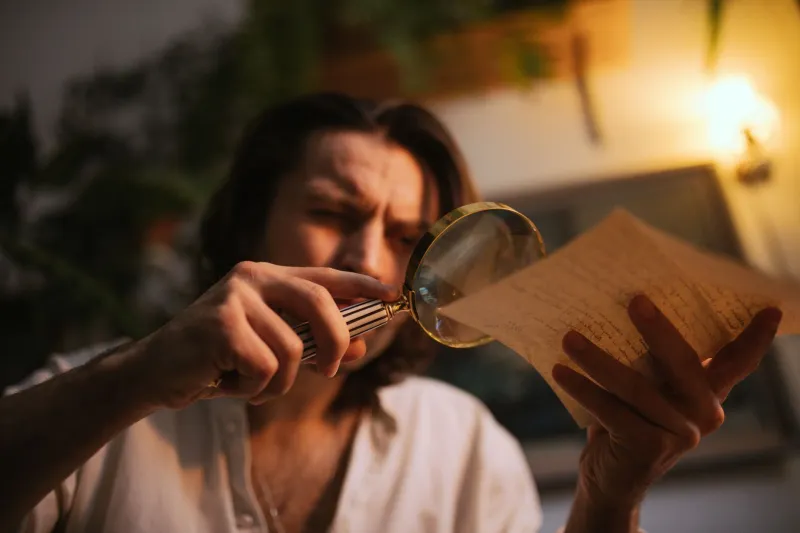
Artists who work seriously tend to leave evidence of their process within the work itself, and learning to read that evidence is one of the more intimate forms of connoisseurship available to the collector. Pentimento — the visible traces of earlier compositional decisions that show through later layers of paint — reveals an artist thinking, reconsidering, and committing. The underpainting visible at a canvas's edge tells you something about how the artist began. The density of marks in a particular zone of a work suggests where the artist's attention was most concentrated.
Beyond the physical evidence within the work, process research is now more accessible than it has ever been. Many artists document their studios and working methods through social media, interviews, and artist residency records. Exhibition catalogs frequently include process documentation. Gallery publications often discuss technique in useful detail.
The collector who has read an artist's process notes before standing in front of their work arrives in that encounter with a fundamentally different quality of attention. They are not simply seeing the result — they are seeing the accumulation of decisions that produced it.
Cultural Reference and Coded Meaning
Contemporary art is frequently dense with cultural reference — to literature, music, political history, religious iconography, vernacular visual culture, and the specific social contexts from which the artist emerged. Some of these references are immediately legible; many are not. The collector who takes the time to decode them gains access to a dimension of the work that is entirely closed to those who do not.
This is not to suggest that a work must be intellectually decoded in order to be experienced or enjoyed. Visual art operates on registers that precede and exceed language. But the collector who understands both the sensory and the intellectual dimensions of a work is in possession of something more complete — a relationship with the object that is capable of deepening rather than simply persisting.
When a work confuses or intrigues you, follow the thread. Look up the reference you do not recognize. Read about the cultural context from which the artist emerged. Allow the work to send you somewhere, and then bring what you find back to it. This is, in essence, what it means to collect with genuine seriousness — to let the work teach you, rather than simply decorating your walls with it.