When the Table Becomes the Gallery: America's Most Intentional Hosts Are Curating Dining Experiences Worth Collecting
When the Table Becomes the Gallery: America's Most Intentional Hosts Are Curating Dining Experiences Worth Collecting
There is a moment, arriving at a dinner party hosted by someone who truly understands beauty, when the table itself stops you. Before the first course is served, before conversation begins to flow, you find yourself leaning closer to examine the glaze on a stoneware bowl, tracing the irregular rim of a hand-thrown plate, or wondering about the provenance of a linen runner printed in a limited run of forty. In that pause, something remarkable has occurred: you have become a gallery visitor, and you did not see it coming.
Across the United States, a sophisticated cohort of hosts — designers, collectors, restaurateurs, and devoted home entertainers — is deliberately engineering precisely that moment. They are treating the tablescapes they compose with the same curatorial rigor that once belonged exclusively to museum professionals and serious art collectors. And in doing so, they are quietly expanding what it means to collect original art in America.
The Tablescape as Curated Installation
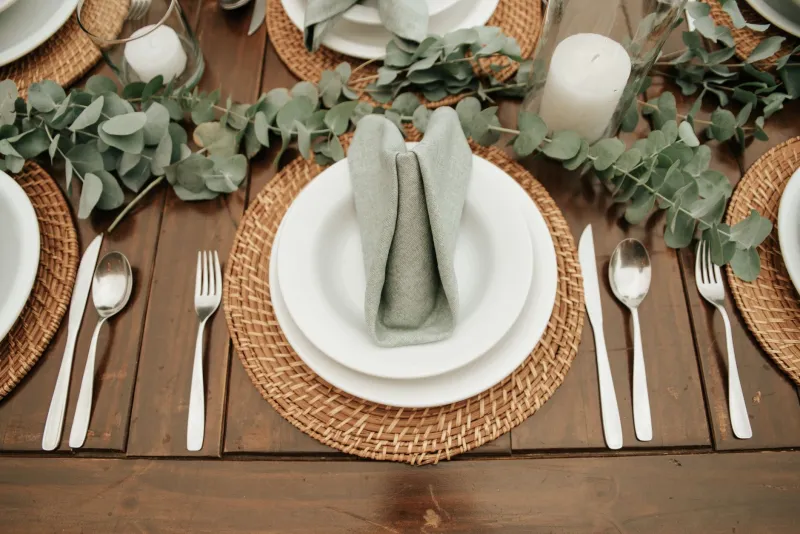
The word "tablescape" has long carried a whiff of the aspirational lifestyle blog — Pinterest boards crowded with pumpkins and pillar candles. What is happening now is something altogether more considered. The hosts driving this movement are not simply styling a surface for a photograph. They are assembling objects with aesthetic intention, provenance, and meaning, sourcing directly from independent artists whose work they follow the way others follow painters or sculptors.
In Charleston, South Carolina, interior designer and habitual host Marguerite Aldren spends months building toward a single dinner table. Her process mirrors the acquisition strategy of any serious collector: she maintains relationships with ceramic artists whose studios she has visited, tracks limited production runs, and will wait a full season for a particular artist to release a new glaze series before planning a menu around it. "The food is the performance," she has said to those who ask about her approach. "The table is the stage, and every object on it has been cast deliberately."
Aldren's tablescapes routinely incorporate wheel-thrown serving vessels from a Lowcountry ceramicist whose work rarely leaves the region, hand-dyed napkins from a textile artist working out of Savannah, and a set of brass candleholders commissioned from a metalsmith she discovered at a small craft fair three years ago. None of these pieces are mass-produced. All of them carry the particular weight of objects made by a single pair of hands.
Sourcing With the Collector's Eye
In Portland, Oregon, where independent craft culture runs particularly deep, food writer and entertainer Declan Ostrowski approaches his table with what he calls "the same discipline I'd apply to buying a print." He maintains a rotating collection of ceramic pieces — some functional, some purely decorative — that migrate between kitchen shelves and the dinner table depending on the occasion. His sourcing is methodical: he follows ceramic artists on social media not for the imagery but for the process, watching for the moment a new series enters production.
"When you buy a handmade plate from an artist you've followed for two years, you bring a story to the table," Ostrowski explains. "Guests eat from it differently. They hold it differently. That's not something a retail store can give you."
This orientation toward narrative and provenance is precisely what distinguishes the new American tablescape collector from the casual home stylist. The objects they choose are not interchangeable. They accumulate meaning over time, much as works in a private art collection do — carrying with them the memory of the dinner at which they first appeared, the conversation they sparked, the guest who asked where they came from.
Chicago's Intimate Gallery Dinners
Perhaps nowhere is the convergence of art collecting and table curation more formally expressed than in Chicago, where a small but growing circle of hosts has begun staging what they call "gallery dinners" — intimate evenings in which the table itself is as deliberately composed as any installation in the city's renowned museum district.
Among them is Theodora Callum, a private art consultant who began incorporating original works into her tablescapes after recognizing that her dinner guests engaged more deeply with art encountered in a domestic setting than in any gallery she had taken them to professionally. "There is something about holding a cup made by an artist's hands while you are talking and eating and laughing," she reflects. "The guard comes down. The object becomes part of your experience rather than something you observe from a respectful distance."
Callum's approach has evolved into a formal practice. She now commissions pieces specifically for individual dinner occasions — a set of sake vessels for an evening themed around Japanese ceramics, a series of small relief prints placed at each setting as both decoration and take-home keepsake. Her guests, she notes, have begun collecting in earnest themselves, having been introduced to artists through the intimacy of her table.
Why the Table Invites What the Gallery Wall Cannot
The gallery wall, for all its authority, maintains a certain distance. Art hung above the sightline, behind glass, or roped off from touch communicates through the eye alone. The table, by contrast, demands full sensory engagement. A guest lifts a ceramic pitcher, feels its heft, notices the slight asymmetry that confirms it was shaped by hand. They run a thumb across the texture of a hand-printed placemat. They eat from a bowl whose interior glaze shifts color in candlelight. The encounter is not passive observation — it is participation.
This is the particular power that America's most intentional hosts have recognized and are now cultivating deliberately. The table, they understand, is the most democratic of gallery spaces: it requires no admission, no hushed reverence, no prior knowledge of art history. It asks only that you sit down, be present, and pay attention.
For collectors, this represents a genuinely compelling expansion of the practice. Acquiring original ceramics, handcrafted textiles, and limited-edition prints for use at the table is not a lesser form of collecting — it is, arguably, a more demanding one. These objects must be beautiful and functional. They must hold up to use, to conversation, to the unpredictable theater of a dinner party. And they must reward repeated attention, revealing new qualities each time they appear.
Building a Table Collection Worth Passing Down
The most experienced practitioners of this approach have begun thinking about their table collections in generational terms. Marguerite Aldren speaks of certain ceramic sets the way other collectors speak of paintings: as objects she intends to keep, to care for, and eventually to pass along. Theodora Callum has begun documenting the provenance of each commissioned piece — the artist's name, the date of production, the occasion for which it was made — treating the record with the same seriousness she brings to her clients' fine art inventories.
This is the natural destination of any serious collecting practice: the recognition that what one has assembled carries value beyond the personal, that the objects chosen with genuine discernment are worth preserving and transmitting.
At Savery Gallery, we have long understood that sophisticated taste does not confine itself to the canvas or the sculpture plinth. It finds expression wherever beauty and intention meet — and there are few places that intersection is more alive, or more savory, than a table set by someone who truly knows how to look.