The Dining Room as Gallery: How Intentional Art Curation Is Transforming the American Table
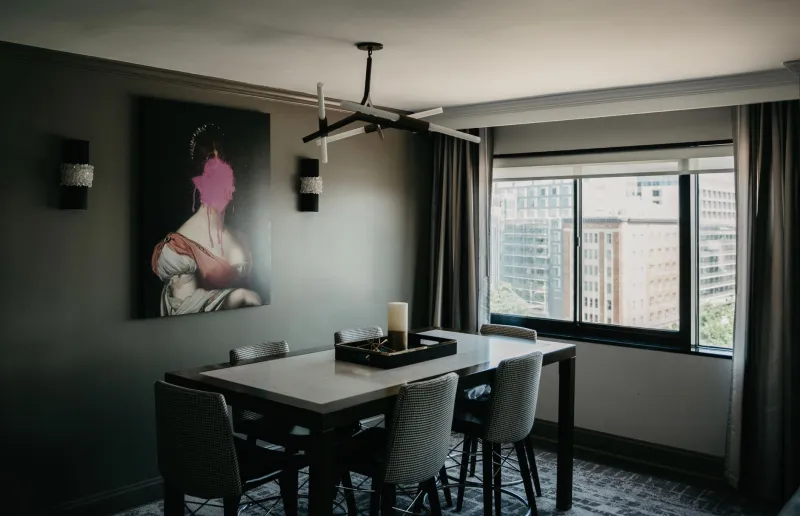
There is a particular kind of dinner party — the sort one remembers not only for the food but for the feeling of the room itself. The candlelight catches the surface of an oil painting hung at precisely the right height. A large-format photograph arrests your gaze between courses. A sculptural ceramic piece anchors the sideboard with quiet authority. These details are not accidental. They are, increasingly, the result of the same careful thought that goes into selecting a wine pairing or composing a tasting menu.
Across the United States, a discerning class of hosts is reimagining the dining room as something more than a functional space for eating. They are treating it as a personal gallery — one in which the artwork is chosen not merely to fill space, but to deepen the entire sensory experience of gathering around a table.
Where Culinary Intention Meets Visual Intelligence
The connection between food and art is ancient. Renaissance banquets were staged with theatrical backdrops. Victorian dining rooms were hung salon-style with oil portraits meant to communicate lineage and taste. What is new, in the contemporary American context, is the democratization of this sensibility. One no longer needs a manor house or an inherited collection to approach the dining room with genuine curatorial ambition.
New York-based interior designer Claire Ashford, whose residential projects have been featured in several national design publications, describes the shift she has witnessed among her clients over the past decade. "The dining room used to be the last room people thought about when it came to art," she explains. "Now it is often the first. My clients understand that the walls are setting a tone for everything that happens in that room — the conversation, the mood, the memory of the evening."
This philosophy aligns with a growing body of research in environmental psychology suggesting that visual stimuli meaningfully influence how people experience taste, conversation, and emotional comfort. A room that engages the eye with genuine artistic merit, the thinking goes, elevates the entire register of the experience it contains.
Scale: The Most Common Mistake, and How to Avoid It
For collectors and first-time buyers alike, scale is where the most consequential decisions — and the most common errors — occur. A single modestly sized painting on a large dining room wall can read as an afterthought rather than a statement. Conversely, a work that overwhelms the proportions of the room can feel oppressive rather than commanding.
The general principle that experienced collectors follow is to treat the primary wall of the dining room — typically the one most visible from the table — as a focal anchor. A single substantial work, whether a large canvas, a triptych, or a framed textile, tends to read with far more authority than a cluster of smaller pieces fighting for attention. When a grouping is desired, interior designers often recommend treating it as a unified composition, with consistent framing or a deliberate visual logic that holds the arrangement together.
San Francisco collector and restaurateur David Merritt, who has spent fifteen years assembling a collection that moves freely between his home and his dining establishments, puts it plainly: "The worst thing you can do is hang something because it fits the space. The best thing you can do is find the work first and then let the space respond to it."
Lighting: The Element That Changes Everything
Art in the dining room exists in a uniquely dynamic lighting environment. Unlike a dedicated gallery wall in a living room, which is typically viewed under consistent ambient light, dining room art must perform across the full range of a meal — from the bright clarity of a Sunday lunch to the warm, contracted glow of an evening dinner party.
Picture lights mounted directly to frames offer a traditional and highly effective solution, providing consistent illumination regardless of the room's ambient conditions. Adjustable track lighting, when installed with care, allows for flexibility as the collection evolves. What experienced collectors consistently caution against is relying solely on overhead fixtures, which tend to flatten the surface of a painting and eliminate the dimensionality that makes original works compelling in person.
For those working with works on paper, photography, or mixed media, UV-protective glass is not merely a conservation consideration — it also meaningfully affects how a piece reads under artificial light, reducing glare and allowing the work to be appreciated without obstruction.
Subject Matter: Appetite, Abstraction, and the Art of Suggestion
The question of what to hang in a dining room is one that invites more creative latitude than many collectors initially assume. Traditional still-life paintings — the Dutch masters' gleaming fruit, the French school's laden tables — remain perennially appropriate, and for good reason. They speak directly to the pleasures of abundance and the beauty of material things, themes that resonate naturally in a space devoted to shared meals.
However, the most compelling dining rooms curated by contemporary collectors tend to resist the obvious. Abstract work, landscape painting, portraiture, and even politically engaged art have all found powerful homes above the dining table. What matters, designers and collectors agree, is not subject matter per se, but emotional resonance. The work should invite contemplation without demanding it — present enough to enrich the room, open enough to allow conversation to breathe.
Ashford advises her clients to ask a simple but clarifying question when evaluating a potential acquisition for the dining room: "Does this piece make you want to linger?" It is, she suggests, the most reliable test of whether a work is genuinely suited to a space built around the pleasures of staying at the table.
Collecting for the Table: A Long-Term Perspective
Perhaps the most meaningful shift in how design-forward Americans are approaching the dining room is the move away from decoration as a one-time act and toward collecting as an ongoing practice. Rather than furnishing a room and considering it complete, these hosts treat the walls as a living element of the home — one that evolves as their taste deepens and their relationships with artists and galleries develop.
This approach transforms the dining room into something genuinely personal: a space that reflects not only aesthetic preference but intellectual curiosity, cultural engagement, and the accumulated history of a collector's eye. Guests, it turns out, notice. The art on the walls becomes part of the conversation — another course, in its way, offered by a host who understands that the pleasures of a fine evening are always more than the sum of what is served.