Seeing Before the World Sees: Inside the Mind of America's Elite Art Collectors
Seeing Before the World Sees: Inside the Mind of America's Elite Art Collectors
There is a particular quality of stillness that descends upon a serious collector when they encounter a work that matters. The casual visitor to a gallery opening moves through the room with a drink in hand, registering color and scale, perhaps pausing for a moment of aesthetic pleasure before moving on. The collector, by contrast, stops. Something in the composition, the handling of light, or the conceptual weight of the piece arrests their attention in a way that is difficult to articulate but unmistakable in its effect. This is the collector's eye — and it is not born overnight.
Across the United States, a relatively small community of collectors has developed this faculty to a remarkable degree. They are the individuals whose acquisitions, made quietly and often years in advance of critical consensus, form the basis of major museum collections, high-profile auction results, and the cultural conversations that shape American art history. Understanding how they operate offers not only a fascinating psychological portrait but also a practical roadmap for anyone who aspires to collect with greater intention and sophistication.
The Foundation: Cultural Education as a Living Practice
Among the collectors who consistently identify significant work early, formal art education is less common than one might expect. What they share instead is a commitment to cultural education as an ongoing, lived practice rather than a credential to be earned and set aside. They visit galleries and museums not as occasional leisure but as a habitual discipline. They read criticism — not only to absorb conclusions but to understand the frameworks through which critics think. They engage with artists, attend studio visits, and follow the arc of careers across years and even decades.
Eleanor Marsh, a Chicago-based collector who began acquiring work in the early 1990s on a modest budget and now holds a collection regarded by peers as among the most prescient in the Midwest, describes her approach as one of sustained attention. "You have to look at an enormous amount of work," she has said. "Not to find what you like immediately, but to understand the full range of what is being made. Without that context, you cannot recognize the exceptional when it appears."
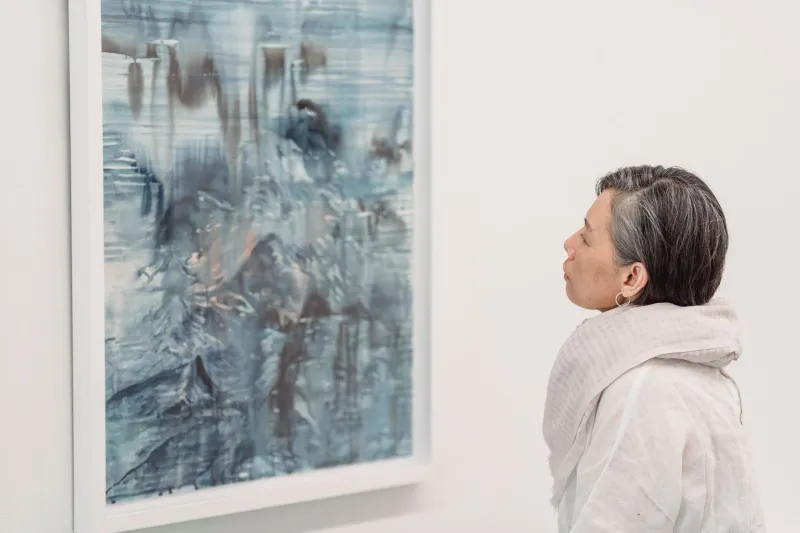
 Photo: Eleanor Marsh, via i.pinimg.com
This breadth of visual experience functions as a kind of internal database. When a collector encounters a work that departs meaningfully from what surrounds it — that demonstrates a mastery of tradition while simultaneously pushing against its boundaries — they register the distinction not through conscious analysis alone but through a pattern recognition that has been refined over years of attentive looking.
Gut Instinct and Its Misunderstood Role
The language of instinct is frequently invoked in discussions of collecting, sometimes to the point of mystification. Elite collectors do speak of a visceral response to significant work — a quickening of attention, a sense of inevitability about a particular piece. But it would be a mistake to treat this instinct as something separate from knowledge. In practice, what presents as intuition is most often the rapid, unconscious synthesis of accumulated expertise.
Dr. James Okafor, a New York-based collector and former professor of art history, draws a useful distinction between reactive preference and informed response. "Anyone can have a strong reaction to a painting," he notes. "What the experienced collector brings is the ability to interrogate that reaction — to ask whether it is personal taste, genuine significance, or both. Those are not always the same thing."
 Photo: Dr. James Okafor, via as2.ftcdn.net
The most effective collectors develop the habit of pausing to examine their own responses with a degree of critical detachment. They ask whether the work's power derives from novelty alone or from a more durable conceptual or formal achievement. They consider whether the artist is solving a problem that matters within the broader conversation of contemporary practice, or simply producing work that is visually appealing within the conventions of a particular moment.
Market Savvy Without Market Capture
A sophisticated collector understands the art market without being governed by it. This is a distinction of considerable importance. The market — meaning auction results, gallery pricing, critical attention, and institutional acquisition — is a lagging indicator of cultural value, not a leading one. By the time a work commands significant prices at auction, the collector who identified the artist years earlier has already made their acquisition and, more importantly, has already participated in the cultural recognition that the market is only now catching up to.
This does not mean that elite collectors ignore market signals entirely. They follow gallery representation closely, noting when emerging artists move to more prominent representation or when institutional curators begin expressing interest. They pay attention to the provenance of works being offered and to the trajectory of careers over time. But they use this information as context rather than instruction.
The practical implication for aspiring collectors is significant: the most meaningful acquisitions are rarely made at the moment of maximum visibility. They are made in the years before consensus forms, when the risk is higher but the cultural and financial rewards are proportionally greater.
Developing Your Own Collector's Eye
For those who wish to cultivate a more discerning approach to collecting, the path is demanding but well-defined. Begin with sustained, disciplined looking. Visit as many exhibitions as possible — not only in major metropolitan centers but in the regional galleries and artist-run spaces where significant work so often first appears. Develop relationships with gallerists and artists whose judgment you come to trust, and treat those relationships as long-term investments in shared knowledge.
Read widely in art criticism and art history, not to absorb received opinion but to understand the intellectual frameworks that inform how work is evaluated. Study the careers of artists you admire in depth, tracing the development of their practice across time. And cultivate the discipline to distinguish between what you find personally appealing and what you recognize as genuinely significant — understanding that the two need not be mutually exclusive, but that they are not automatically the same.
At Savery Gallery, we have long held that the collector's eye is not a gift reserved for the few. It is a faculty that can be developed through commitment, curiosity, and the willingness to engage with art as a serious and enduring practice. The works that belong on your walls are not simply those that please you in a passing moment. They are the ones that continue to reward sustained attention — that reveal new dimensions the longer you live with them.
 Photo: Savery Gallery, via en.kalkalpen.at
That, ultimately, is the standard by which the most discerning collectors in America make their choices. And it is a standard worth aspiring to.