From Cellar to Canvas: How the Wine Collector's Eye Is Reshaping the American Tasting Room
From Cellar to Canvas: How the Wine Collector's Eye Is Reshaping the American Tasting Room
There is a particular kind of attention that serious collectors bring to a bottle of wine. They consider the vintage, certainly, but also the producer's philosophy, the specific plot of land from which the grapes were drawn, and the way time itself has shaped what now rests in the glass. It is a layered, patient form of looking — one that, as it turns out, translates with remarkable fluency to the acquisition of original art.
Across the United States, a distinct class of collector has begun to recognize this overlap not merely as coincidence but as inevitability. The sensibility that drives someone to cellar a case of 2013 Napa Valley Cabernet Sauvignon for a decade before opening it is the same sensibility that compels them to live with a painting long enough to understand what it is truly saying. Both pursuits demand an education of the eye, a tolerance for complexity, and a willingness to invest in things that reward sustained attention.
The Shared Language of Provenance and Craft
Wine collectors speak fluently about provenance — the chain of custody that authenticates a bottle's history and elevates its value. Art collectors speak the same language, tracing a work's lineage through exhibition records, gallery representation, and prior ownership. The vocabulary is nearly identical because the underlying concern is the same: origin matters. Where something comes from, and who was responsible for its creation, shapes the meaning it carries into the present.
This shared grammar has made the transition from cellar to canvas a natural one for many American collectors. A San Francisco-based collector who has spent two decades acquiring wines from Burgundy's most storied domaines will recognize, almost intuitively, the same markers of distinction in a work by a painter who has spent years developing a singular, disciplined practice. Both the winemaker and the artist are, in essence, translating a specific relationship with materials and place into something that can be experienced by others.
Terroir — that untranslatable French concept describing the way geography, climate, and soil express themselves in a wine — has become a touchstone for collectors who move between these two worlds. They seek out artists whose work carries an equivalent sense of rootedness: painters whose canvases seem to hold the light of a particular landscape, ceramicists whose vessels speak to the earth from which their clay was drawn, and printmakers whose imagery is inseparable from a specific regional tradition.
Designing the Cellar as an Intentional Space
The tasting room, once an afterthought in even the most serious collector's home, has emerged as one of the most considered spaces in American domestic life. It is no longer sufficient to line a temperature-controlled room with racks of bottles and call it complete. Today's discerning collector understands that the environment in which wine is experienced shapes the experience itself.
This understanding has prompted a significant shift in how collectors approach the walls, surfaces, and objects that surround their cellars. Original works of art — selected with the same rigor applied to acquiring the wines themselves — have become central to these spaces. A large-scale oil painting depicting the abstract geometry of vineyard rows at dusk creates an entirely different atmosphere than a mass-produced print, and the collector who has trained their palate to distinguish between the two in a glass has little difficulty making the same distinction on a wall.
Artists whose work engages directly with themes of agriculture, landscape, and process have found a particularly receptive audience among wine collectors. Works that reference the cycles of cultivation — the dormant vine in winter, the heavy cluster of fruit in late summer, the amber light of harvest — resonate with collectors who understand these rhythms firsthand. Still-life painters working in the tradition of the Dutch Golden Age, updated for a contemporary American sensibility, have also found devoted patronage among those who appreciate the way a single, carefully rendered bottle can become a meditation on time and pleasure.
Artists Worth Knowing at the Intersection of Wine and Art
For collectors seeking to bridge these two passions, a number of American artists merit serious attention.
Painters working in the plein air tradition — particularly those based in California's wine country, Virginia's Shenandoah Valley, or Oregon's Willamette Valley — bring an immediate connection to the landscapes that produce some of America's most celebrated wines. Their work captures not just the visual character of these regions but something of their seasonal rhythm and atmospheric quality.
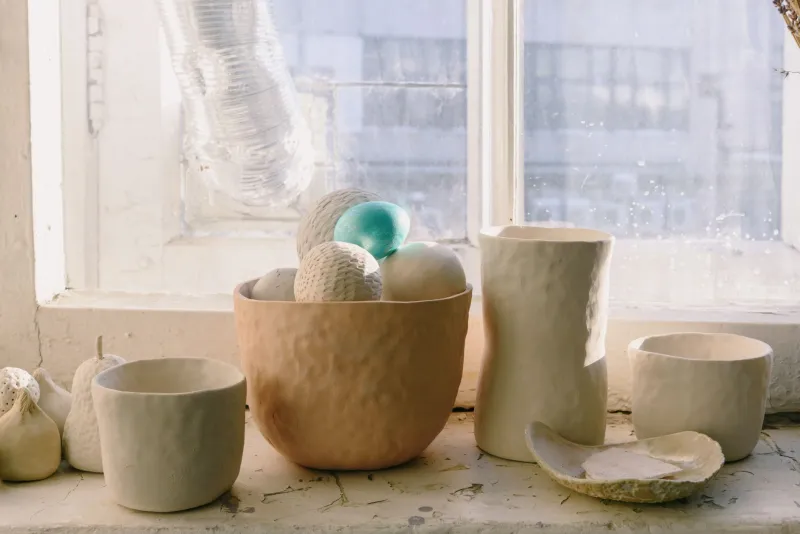
Ceramicists who draw on the vessel as their primary form offer another compelling avenue. The act of drinking wine from a handmade cup or decanting it into a carefully considered carafe extends the collector's engagement with craft into the ritual of consumption itself. Artists working in this tradition — many of whom have studied historical Japanese and Korean ceramic forms alongside European studio pottery — produce objects that occupy a meaningful space between utility and art.
Finally, photographers who have devoted sustained attention to wine culture — its landscapes, its labor, and its quieter moments of contemplation — represent an accessible entry point for collectors who are newer to acquiring original works. Limited-edition fine art prints, produced in small editions and signed by the artist, carry the same logic of scarcity and intentionality that wine collectors already understand well.
Practical Guidance for the Collector Ready to Bridge Both Worlds
For those prepared to extend their collecting eye from the bottle to the wall, a few principles offer reliable guidance.
Begin with what you already know. A collector who has spent years developing a deep affinity for the wines of a particular region should allow that affinity to inform their initial art acquisitions. Artists connected to those landscapes — geographically, thematically, or philosophically — offer a natural starting point that requires no artificial leap of imagination.
Prioritize original works over reproductions. Just as a serious wine collector would not substitute a mass-produced label for a small-production estate wine, the same standard applies to art. Original works, even by emerging artists, carry a depth of intention and craft that reproductions cannot replicate.
Engage directly with artists and galleries. The most meaningful acquisitions in any collecting discipline come from genuine relationships. Visiting open studios, attending gallery exhibitions, and speaking with artists directly about their practice yields the kind of contextual knowledge that transforms a purchase into a collection.
Consider the space holistically. The cellar and tasting room deserve the same curatorial attention as any other room in the home. Lighting, scale, and the relationship between objects all contribute to the experience of the space — and, by extension, to the experience of the wine itself.
A Unified Aesthetic Identity
The collector who moves fluently between the cellar and the gallery has arrived at something rare: a life organized around a coherent set of values. Both pursuits celebrate patience, craftsmanship, and the particular pleasure of things made with genuine intention. Both reward sustained attention and resist the appeal of the merely fashionable.
At Savery Gallery, we believe that this convergence is not a trend but an expression of what connoisseurship has always been — the recognition that beauty, in whatever form it takes, deserves to be sought out, understood, and lived with over time. The collector who has learned to read a glass of wine with genuine discernment has already developed the most essential skill for collecting art. The only remaining step is to trust that same eye when it turns toward the wall.