Spirits as Sculpture: How Design-Forward Collectors Are Elevating the Bar Cart to Gallery Status
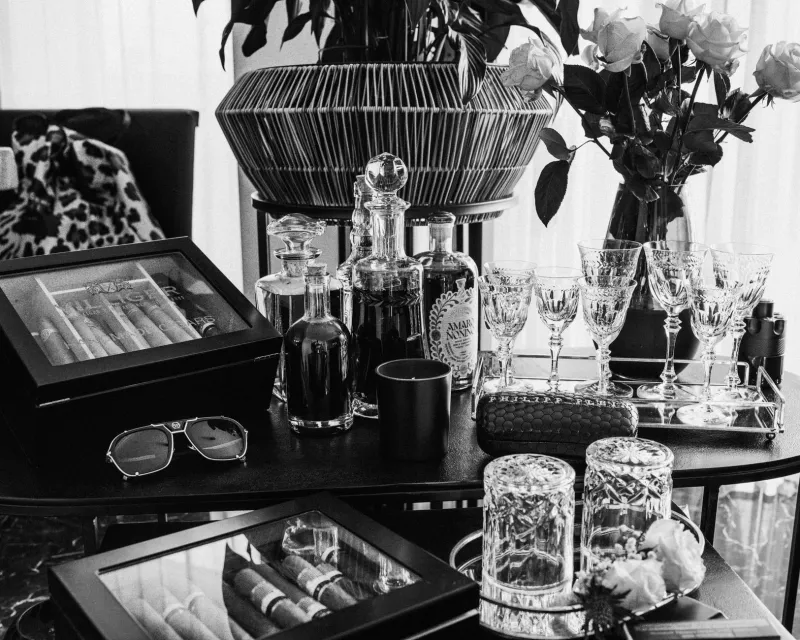
There is a moment, in the homes of certain American collectors, when a guest pauses mid-conversation — not to admire a painting or a ceramic piece displayed on a dedicated shelf — but to study the bar cart standing near the window. The light catches the amber of a single-malt Scotch inside a hand-blown decanter. A small oil painting, no larger than a hardcover book, leans casually against the wall behind it. A pair of crystal coupes, their stems catching the late afternoon sun, complete the composition. It is, in every meaningful sense, a curated installation.
This is not an accident. It is a philosophy.
The Bar Cart as Exhibition Space
For much of the twentieth century, the American bar cart occupied a curious middle ground — functional enough to be useful, decorative enough to be noticed, but rarely treated with the same deliberate intention one might bring to hanging a painting or arranging a bookshelf. That is changing, and the shift is happening at the intersection of three converging cultural forces: the explosive growth of American craft spirits, a renewed appreciation for artisan glassware and handcrafted objects, and a collecting sensibility that refuses to confine beauty to the expected rooms of the home.
"I stopped thinking of my bar cart as a place to keep bottles and started thinking of it as a place to keep things I love to look at," says Marcus Elaine, a Chicago-based interior designer whose residential projects frequently feature what he calls "drinking vignettes" — compositions that treat the act of serving spirits as inseparable from the act of display. "The best bar carts I've designed function like small, rotating exhibitions. Nothing on them is arbitrary."
Elaine is not alone in this thinking. Across the country, collectors who have spent years building serious art collections are turning the same acquisitive eye toward the objects that populate their entertaining spaces. The logic is straightforward: if a handthrown ceramic vessel belongs in a curated arrangement on a sideboard, why should a beautifully proportioned decanter from a Kentucky glassblower be treated any differently?
Composition: The Discipline of the Thoughtful Arrangement
The principles that govern strong gallery installation — scale variation, negative space, the tension between the organic and the geometric — translate with surprising elegance to the bar cart. The most compelling arrangements resist the impulse to fill every available surface. They breathe.
San Francisco collector and spirits enthusiast Diana Cho approaches her brass-and-glass rolling cart the way she approaches arranging works on paper: with an awareness of what each object is doing in relation to its neighbors. "I never have more than three bottles displayed at once," she explains. "Two of them might be purely for their visual presence — the shape of the bottle, the color of the spirit inside. One is always what I'm actually drinking that week. That tension between the aesthetic and the functional is what makes the whole thing feel alive."
Cho's current arrangement pairs a bottle of a small-batch American rye with a hand-forged Japanese whiskey glass she acquired at a craft fair in Portland, Oregon, and a small abstract painting by a Bay Area artist she began collecting several years ago. The painting, she notes, was chosen in part because its warm ochre and sienna tones echo the color of aged spirits. "It wasn't a conscious decision at first," she says. "But once I noticed the harmony, I couldn't un-see it."
Lighting: The Detail That Separates Good from Exceptional
Ask any experienced gallery director what single element most transforms the presentation of an artwork, and the answer will almost always be light. The same principle applies to the composed bar cart, where the interplay of ambient light, directional spotlighting, and the inherent luminosity of glass and liquid can produce effects of genuine visual sophistication.
Elaine recommends treating the bar cart as a miniature stage set. "A small, adjustable picture light mounted on the wall above the cart, aimed slightly downward, will do more for a collection of decanters than any amount of careful arrangement," he says. "The light moves through the glass, it catches the facets of crystal, it deepens the color of the spirits. Suddenly you're not looking at a bar cart — you're looking at something that demands your attention."
Natural light, too, plays a role. Many collectors deliberately position their bar carts near windows, allowing the quality of light to shift across the day and alter the character of the display in the same way that changing gallery lighting transforms a viewer's experience of a painting.
Pairing Handcrafted Objects with Fine Art
The most adventurous collectors are not content to let the bar cart stand alone. They treat it as an anchor for a broader composition that includes original artwork — a small framed piece on the wall above, a ceramic object on an adjacent surface, a sculptural element that bridges the two worlds.
This curatorial instinct is, at its core, an expression of a belief that the objects we surround ourselves with in moments of leisure deserve the same consideration we bring to the objects we call art. A hand-blown decanter produced by an American studio glassblower is, by any reasonable definition, a work of craft that merits serious attention. When it shares a composition with an original painting or a handmade ceramic, the effect is not one of category confusion but of mutual elevation.
"I have a small painting by an artist I've followed for years hanging directly above my bar cart," says New York collector and design writer Nathaniel Broome. "It's an abstract piece — very quiet, very still. And below it, the bar cart has this wonderful rhythm of vertical and horizontal forms: the bottles, the glasses, a small wooden tray. The painting and the cart are in constant conversation with each other. Neither would be as interesting without the other."
The Rotating Exhibition
Perhaps the most sophisticated expression of this sensibility is the bar cart treated not as a fixed installation but as a rotating one — a space that evolves with the seasons, with the collector's current enthusiasms, and with the rhythm of entertaining.
Elaine encourages his clients to approach the bar cart with the same seasonal thinking that the best gallery directors bring to their programming. "In the fall, the palette shifts — darker spirits, heavier glass, perhaps a piece of art with more weight to it. In the summer, you might have something lighter on the cart, more transparency, more air. The whole composition breathes differently."
This is, ultimately, what distinguishes the bar cart as curated installation from the bar cart as convenient storage: intention. The willingness to ask, each time a bottle is placed or a glass is set down, whether this object earns its place — whether it contributes to the composition or merely occupies space.
For those who collect with discernment, the answer to that question shapes everything. And the bar cart, properly considered, becomes one of the most intimate expressions of that discernment in the home.