The Most Overlooked Canvas in Your Home Is Holding Your Bourbon
There is a particular kind of attention that serious collectors bring to every corner of a room. They consider sightlines. They think about negative space. They understand that an object placed with intention carries an entirely different weight than one placed out of convenience. And increasingly, that same discernment is being directed toward a piece of furniture that most Americans have treated as an afterthought: the bar cart.
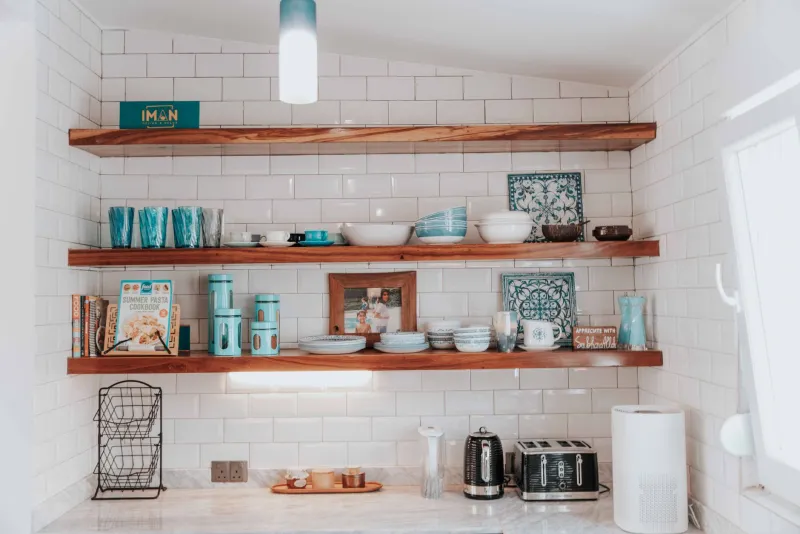
Walk through the homes of the country's most aesthetically deliberate hosts — the ones whose dinner parties feel less like casual gatherings and more like carefully composed experiences — and you will find bar setups that bear little resemblance to the chrome-and-glass rolling trays of decades past. In their place are layered installations: a hand-thrown ceramic ice bucket alongside a signed lithograph propped against the wall, a small-batch rye flanked by a sculptural bitters vessel made by a studio potter in Asheville, a framed original watercolor of a Meyer lemon branch hung just above the tray, its scale chosen with the same care one might give a salon-wall arrangement.
These are not accidental assemblages. They are curated.
Why the Bar Cart Rewards Artistic Attention
The bar cart occupies a uniquely theatrical position in the American home. Unlike a bookshelf or a console table, it is a station of ritual — a place where guests gather before the meal, where the host performs the small ceremony of the pour, where conversation loosens and the evening properly begins. Few pieces of furniture attract as much sustained human attention over the course of a gathering.
And yet, for most of its domestic history, the bar cart has been treated as purely functional. Bottles were arranged by height. Glassware was stacked for efficiency. The aesthetic conversation stopped at the label.
What design-forward collectors have recognized is that this visibility makes the bar cart one of the most powerful display opportunities in the home — and one of the least exploited. The objects placed on and around it are seen repeatedly, at close range, by guests in a relaxed and receptive state of mind. That is, in many ways, the ideal condition for encountering art.
Sourcing with Specificity: The Objects That Belong Here
The collectors and interior tastemakers who have elevated their bar setups to genuine installations tend to approach sourcing with a specificity that mirrors how they build the rest of their collections. The goal is not to decorate around the bottles — it is to create a cohesive visual and tactile conversation between the handmade, the original, and the consumable.
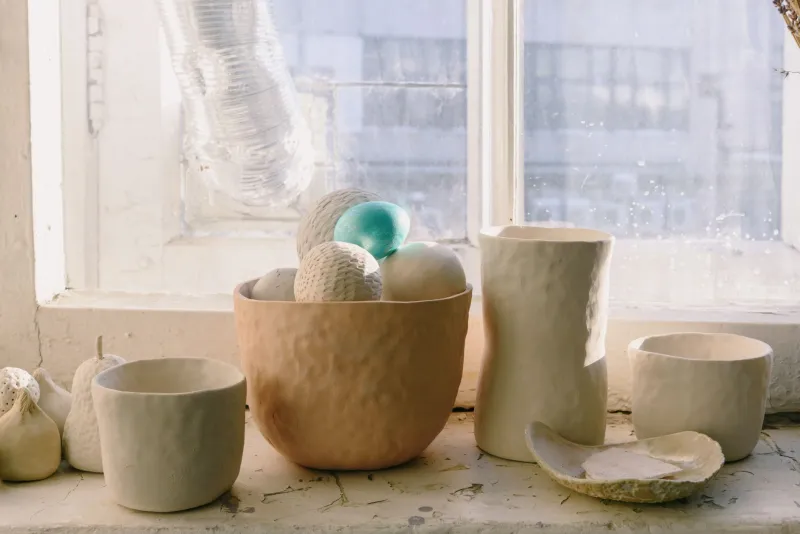
Handcrafted ceramics are, by nearly universal consensus among this set, the foundational category. A hand-thrown coupe or a studio-made cocktail pitcher brings an organic warmth that mass-produced barware simply cannot replicate. American studio potters — particularly those working in stoneware and salt-glazed traditions — produce pieces whose surface textures and subtle irregularities make them genuinely pleasurable to hold and to look at. Sourcing directly from artists through platforms like Savery Gallery or from regional craft fairs allows collectors to acquire pieces with provenance and story, which matters when the bar cart is functioning as a conversation piece in the most literal sense.
Small-scale original works on paper are the second pillar. A botanical illustration, a loosely rendered still life of citrus fruit, or an abstract composition in warm amber and deep green can be framed and propped rather than hung — giving the installation a flexibility that fixed wall art cannot offer. The ability to rotate works seasonally, or to swap in a piece that speaks to the particular spirit being featured, is part of what makes the bar cart such a compelling ongoing project for the collector temperament.
Artisan objects with clear function — a hand-forged bar spoon, a blown-glass carafe, a hand-stitched leather coaster set — bridge the gap between the decorative and the utilitarian in a way that feels entirely appropriate to the context. These are pieces that will be touched and used, which means their materiality matters as much as their appearance.
The Arrangement as Composition
Collectors who have refined their bar setups over time speak about arrangement in the same language they use for hanging a gallery wall. Balance without symmetry. Variation in height and texture. A focal point that anchors the eye before inviting it to wander.
One Chicago-based collector, whose home bar has been described by guests as feeling like a small museum of American craft, speaks of treating each tier of her bar cart as a distinct horizontal plane — each with its own visual logic, its own dominant material, its own moment of surprise. The bottles, in her arrangement, function almost as architectural elements: their vertical lines and warm amber tones create a backdrop against which the handmade objects read with particular clarity.
Another approach, favored by a tastemaker in Marfa, Texas, whose entertaining aesthetic leans toward the spare and the elemental, is to limit the bar installation to a single curated object beyond the spirits themselves — one extraordinary piece that earns its place through sheer quality. Currently, that object is a hand-carved wooden tray by a New Mexico craftsman, its surface worn smooth by use and age. The restraint, he notes, is what makes people stop and look.
Rotating the Exhibition
Perhaps the most sophisticated move available to the collector-host is to treat the bar cart as a rotating exhibition rather than a fixed installation. Seasonal refreshes — swapping in botanically themed ceramics in spring, leaning into richer textures and darker tones in winter — keep the space visually alive and signal to returning guests that this is a home where attention is continuous.
This rotation also creates an opportunity to introduce new acquisitions in a context that invites conversation. A recently purchased piece by an emerging artist, placed on the bar cart before it finds its permanent home, becomes a natural talking point during the cocktail hour — which is, after all, when people are most inclined to ask questions and most open to being genuinely moved by something they hadn't expected to encounter.
The Savory Principle Applied
At Savery Gallery, we have long held that the most interesting collecting happens not in the obvious places — the living room feature wall, the formal dining room — but in the spaces where daily life actually unfolds. The kitchen, the study, the hallway that everyone walks through without quite seeing. The bar cart belongs emphatically in this category.
It is small enough to be approachable. It is visible enough to matter. It is functional enough to anchor every object in lived experience rather than pure aesthetics. And it is, for most American homes, entirely unclaimed territory — a canvas waiting for the collector who understands that the most sophisticated interiors are the ones where the art never stops.
The bourbon can stay. But it deserves better company.