Forged with Intent: How America's Most Discerning Cooks Are Collecting Knives the Way Others Collect Art
Forged with Intent: How America's Most Discerning Cooks Are Collecting Knives the Way Others Collect Art
There is a particular moment, familiar to anyone who has held a truly exceptional knife, when the object in one's hand ceases to feel like a tool. The balance shifts — almost imperceptibly — and what one is left with is something closer to the experience of holding a well-cast bronze or a finely thrown ceramic vessel: an object shaped by a maker's singular intelligence, realized through years of practiced discipline. For a growing number of serious American cooks and collectors, that moment has become not an accident but a pursuit.
The artisan knife market in the United States has expanded considerably over the past decade, drawing collectors who approach blades with the same studied attention they might bring to acquiring a work on paper or a piece of studio glass. These are not casual enthusiasts accumulating kitchen gadgets. They are discerning individuals who research provenance, seek out limited production runs, and speak fluently about the metallurgical distinctions between high-carbon steel and Damascus layering — the way a seasoned collector might discuss the difference between a reduction print and an aquatint.
What Makes a Knife Collectible
The question of what separates a collectible knife from mere kitchenware is, at its core, the same question one asks of any object aspiring to the status of art: does it bear the unmistakable evidence of a singular human hand?
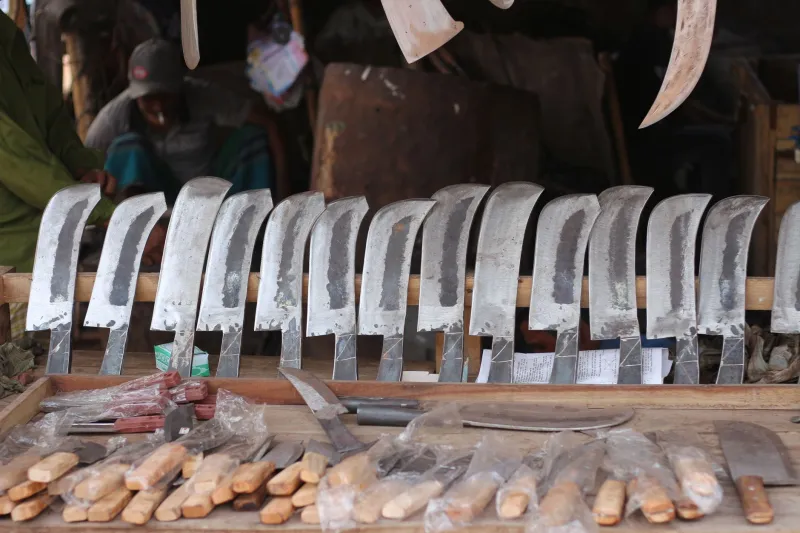
In practical terms, collectors and connoisseurs point to several distinguishing qualities. The steel itself matters enormously. Hand-forged blades — particularly those made from high-carbon steels, or from the layered steel known as San Mai — carry visible evidence of the smith's process in their grain, their temper line, and the subtle irregularities that mass production cannot replicate. The hamon, that luminous boundary between hardened edge and softer spine found in traditionally forged Japanese knives, is prized by collectors much as a ceramicist's brush mark is prized on a glazed vessel: it is the signature of process made visible.
Handle materials further distinguish the extraordinary from the merely excellent. Stabilized wood burl, fossilized mammoth ivory, hand-stitched leather, wrought iron — the most sought-after artisan smiths treat the handle as a sculptural complement to the blade, selecting materials with the same deliberateness a jeweler brings to setting a stone.
Finally, there is the maker. Provenance — that concept so central to art collecting — matters here as much as anywhere. A blade by a recognized smith with a documented waiting list and a coherent aesthetic vision commands a different order of respect, and a different price, than an anonymous production piece. Collectors study makers the way they study painters: following their evolution, acquiring early works, and noting the shifts in a smith's approach across years of practice.
The Makers Drawing Collector Attention
The American artisan knife world encompasses a remarkable range of voices. In the Pacific Northwest, smiths working in the tradition of Japanese bladesmithing — having studied formally in Japan or under American masters — produce gyutos and nakiris of exceptional refinement. Their work circulates in a secondary market that would surprise those who associate knife-buying with a trip to a cookware store.
Elsewhere, makers rooted in the American frontier tradition of the Bowie knife and the hunter's blade have elevated that vernacular into something altogether more considered. Smiths in Tennessee, Texas, and Montana are producing pieces that acknowledge their cultural heritage while demonstrating a formal sophistication — in geometry, finish, and material selection — that places them firmly within the broader conversation about American craft.
The most compelling makers, regardless of tradition, share a quality that collectors consistently cite: intentionality. Every decision — the grind of the blade, the geometry of the spine, the texture of the handle — reflects a coherent aesthetic position. These are not objects assembled from components. They are conceived whole.
Display as Curation
Perhaps the clearest evidence that the knife has crossed from tool to collectible is the care with which serious collectors choose to display their blades. Magnetic wall-mounted installations, custom-built walnut blocks, museum-quality acrylic stands — the vocabulary of display has migrated from the gallery wall into the kitchen and study with remarkable sophistication.
For many collectors, the knife occupies a genuinely liminal space: it is displayed as a sculpture, handled as an instrument, and experienced as both simultaneously. This duality, far from creating tension, is precisely what draws the most thoughtful collectors. Unlike a painting or a ceramic, which one admires from a respectful distance, the artisan knife demands physical engagement. It rewards use. Its beauty is inseparable from its purpose — and for collectors accustomed to art that merely hangs, this quality feels genuinely revelatory.
Some collectors organize their acquisitions thematically, grouping Japanese-influenced blades separately from American craft traditions, or arranging knives chronologically to trace a maker's development. Others mix freely, allowing formal affinities — a shared quality of steel finish, or a recurring geometry — to create visual coherence across disparate traditions. In either case, the sensibility at work is unmistakably that of the curator.
Guidance for the Discerning First-Time Collector
For those approaching this world for the first time, a few principles apply with particular force.
Begin with research rather than acquisition. The most respected makers maintain waitlists that can extend a year or more, and understanding whose work merits that patience requires immersion in the community. Online forums, regional knife shows, and the social media presence of established smiths all provide access to the conversation — and to the standards by which serious collectors evaluate new work.
Handle before committing, whenever possible. Balance, weight distribution, and the tactile quality of the handle are not communicable through photographs alone. Collectors who have attended events such as the Blade Show in Atlanta or regional craft fairs consistently report that direct handling transformed their understanding of what they were seeking.
Consider function alongside aesthetics. The most enduring collections are those in which the objects are genuinely used. A blade that never meets a cutting board is, in some essential sense, incomplete. The finest artisan knives are designed to perform at the highest level — and using them, rather than sequestering them behind glass, honors both the maker's intention and the collector's own discernment.
Finally, document your acquisitions with the same rigor one would apply to any significant collection. Maker correspondence, certificates of authenticity, photographs of the forging process — these materials constitute the provenance record that will matter both to future collectors and to one's own understanding of what has been assembled.
A New Frontier for the Serious Collector
The artisan knife occupies a position in contemporary collecting that is, in its way, reminiscent of studio ceramics a generation ago: undervalued by the mainstream, passionately championed by a devoted community, and quietly accumulating the cultural weight that will, in time, bring it into broader recognition. Those who are paying attention now — who are building relationships with makers, acquiring early and exceptional work, and approaching their blades with the same seriousness they bring to any significant collection — are positioned at the leading edge of something genuinely interesting.
At Savery Gallery, we have always believed that the most compelling collecting happens at the boundaries: where function meets form, where craft aspires to art, and where the discerning eye recognizes value before the market catches up. The artisan knife, in this moment, stands squarely at that boundary. The question is simply whether one is prepared to look.