Before the First Course: How America's Most Intentional Hosts Are Transforming the Aperitivo Hour Into Living Art
Before the First Course: How America's Most Intentional Hosts Are Transforming the Aperitivo Hour Into Living Art
There is a particular kind of host who understands that a dinner party does not begin at the table. It begins the moment a guest crosses the threshold — in the quality of the light, the scent drifting from the kitchen, the music chosen not by algorithm but by hand, and the art on the walls that sets the emotional key for everything that follows. For this host, the aperitivo hour is not a waiting room. It is the overture.
Across the United States, a growing community of entertainers is approaching the pre-dinner ritual with the same deliberateness they bring to collecting original artwork or sourcing single-origin ingredients. They are pairing small-batch vermouths and hand-crafted bitters not merely with olives or charcuterie, but with a carefully considered visual and sensory environment — one in which every element, from the glassware to the framed work above the credenza, has been chosen with intention.
The aperitivo, long a cornerstone of Italian social culture, has found fertile ground in the American imagination precisely because it resists the tyranny of the agenda. It is unhurried by design. And for collectors who have spent years learning to look slowly — to stand before a painting and let it speak rather than rushing to the next gallery room — that unhurried quality feels like home.
The Collector's Eye, Applied to Hospitality
What distinguishes these hosts from the merely stylish is a disposition that will be familiar to anyone who has ever deliberated over the placement of a work on paper or agonized over the right frame: they are curators, even when the medium is an evening.
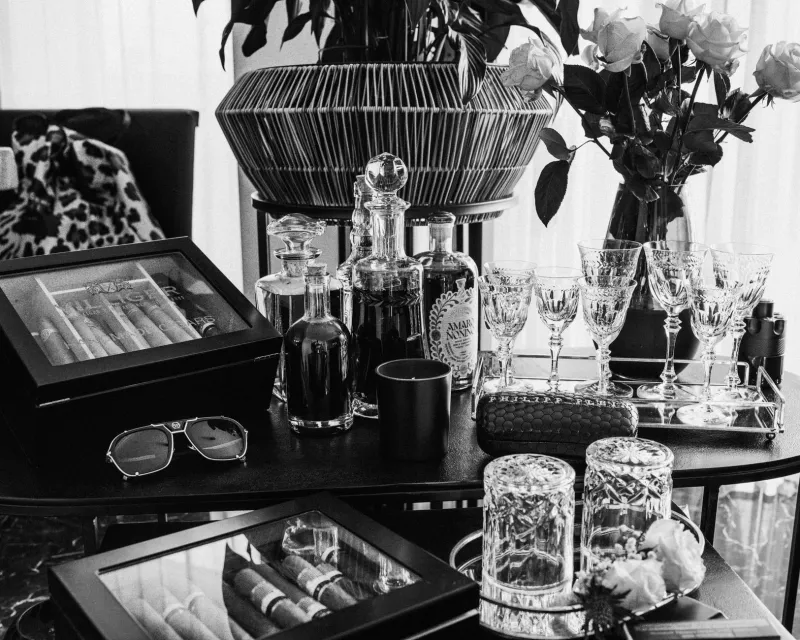
Consider the approach of hosts in cities like Chicago, Portland, and Savannah who have begun treating their aperitivo arrangements as rotating installations. The bar cart — stocked with carefully sourced amaro, dry vermouth from small American producers, and house-made citrus bitters — is positioned deliberately in relation to the artwork surrounding it. A richly pigmented abstract canvas in burnt sienna and ochre might anchor a selection of aged spirits; a quieter, more contemplative work on paper might set the tone for a lighter, floral aperitif. The conversation between object and drink is not accidental. It is composed.
This sensibility extends to the vessels themselves. Antique coupe glasses sourced from estate sales, hand-blown tumblers from American craft studios, ceramic dishes bearing the marks of individual makers — each piece is chosen as one might choose a work for a collection: for its quality, its provenance, and the way it contributes to a coherent whole.
Tablescaping as Editorial Practice
The tablescape — that arrangement of objects on a surface intended to create visual pleasure — has long been the province of the design-minded. But the most thoughtful hosts are now treating it as something closer to an editorial act: a selection of objects that tells a story, establishes a mood, and invites the guest into a particular way of seeing.
Linen napkins in muted, natural tones. A single branch of something seasonal. A small work on paper propped against a stack of art books. Candlelight that flatters both the faces of the guests and the texture of a painting across the room. These are not decorative gestures; they are decisions made by someone who understands that beauty is cumulative, that the whole exceeds the sum of its parts when every part has been chosen with care.
The aperitivo table, in this context, becomes an extension of the collector's sensibility into the realm of lived experience. It is a way of saying: the objects in this room matter. The time we are spending together matters. Even this hour — before the meal, before the conversation deepens — is worthy of your full attention.
Sound, Scent, and the Invisible Architecture of an Evening
The most accomplished hosts will tell you that the visual environment is only one dimension of a well-composed aperitivo hour. Sound and scent are equally powerful, and equally deserving of curation.
Music, chosen with the same care one might apply to selecting a work of art, establishes an emotional register that guests absorb without quite realizing it. A host in Nashville described her practice of building aperitivo playlists the way she builds a collection — beginning with something that arrests attention, moving through works that deepen the experience, and concluding with something that leaves the listener ready for what comes next. Jazz, ambient classical, and certain strains of contemporary American folk have all found their place in her rotation, depending on the nature of the evening and the character of the guests.
Scent, meanwhile, operates on the most immediate and least rational of our senses. The smell of a beeswax candle, of fresh herbs bruised at the moment of arrival, of a vermouth whose botanicals drift across the room — these are details that a guest may never consciously register but will carry with them in the form of a feeling: that this was an evening unlike others.
Practical Wisdom for the Aspiring Aperitivo Host
For those who wish to bring this sensibility to their own entertaining, the entry point need not be elaborate. The aperitivo tradition is, at its core, about generosity of spirit and quality of attention — qualities that cost nothing but intention.
Begin with the drink itself. Seek out small-batch American vermouth producers — there are now excellent examples emerging from California, New York, and the Pacific Northwest — or explore the growing category of domestic amaro. These are spirits made by people who care deeply about their craft, and that care is perceptible in the glass.
Then consider the space. What work of art is already present that might anchor the experience? What object on your shelves — a ceramic piece, a piece of sculptural glass, a small painting — might be brought into closer conversation with the aperitivo table? You need not acquire anything new. The collector's practice of looking freshly at what one already owns is itself a form of curation.
Finally, resist the impulse to fill every silence. The aperitivo hour is designed for the kind of conversation that unfolds slowly, that follows the rhythm of a good pour rather than the pace of a crowded cocktail party. Set the scene, offer the drink, and then allow the evening to find its own tempo.
The Hour That Sets the Tone for Everything
There is a reason that the most memorable dinner parties are often remembered not for the food — however excellent — but for how they felt from the very beginning. The aperitivo hour, when approached with a collector's intentionality, does something that no single dish or wine can accomplish alone: it creates a continuous aesthetic experience that carries the guest from arrival to departure without a single jarring note.
This is the ambition of the hosts who are reshaping the American entertaining ritual. Not to impress, but to immerse. Not to perform sophistication, but to share it — generously, quietly, and with the conviction that beauty, in all its forms, is always worth the effort.
At Savery Gallery, we believe that the collector's eye does not stop at the frame's edge. It extends into every room, every gathering, every hour given over to the pursuit of a life lived with discernment. The aperitivo hour, it turns out, may be one of the most elegant canvases available to us.