Art First: The Design Philosophy That Begins With the Work on the Wall
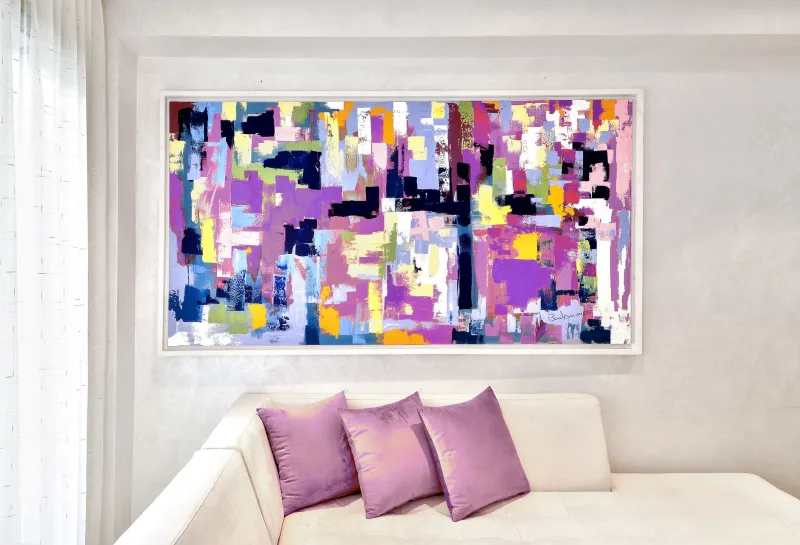
For generations, the conventional wisdom of American interior design has followed a reliable sequence: select the architecture, choose the furniture, settle on a palette, and then — somewhere near the end of the process, often as an afterthought — hang something on the wall. Art, in this framework, has functioned as punctuation rather than as the sentence itself.
A quieter but increasingly influential movement is challenging that sequence entirely. Among a discerning cohort of homeowners, collectors, and design professionals across the United States, the original work of art is no longer the final decision in a room. It is the first.
Reversing the Sequence
The philosophy is straightforward in concept, though it demands genuine confidence in practice. Rather than purchasing a painting to complement an existing sofa or sourcing a print that coordinates with already-chosen wallpaper, adherents of this approach identify a single work of art — one that commands their attention, speaks to their sensibility, and possesses what serious collectors often describe as staying power — and then build the entire environment outward from it.
This is not a decorating trend. It is a fundamental reorientation of how one understands the relationship between a living space and the objects within it.
Consider what changes when a large-scale oil painting becomes the foundational decision in a dining room rather than an accessory to it. The painting's dominant tones inform the plaster color selected for the walls. Its scale dictates the proportions of the table beneath it. The weight of its brushwork suggests whether the surrounding furniture should be spare and recessive or richly upholstered. Every subsequent choice in the room enters into conversation with the work rather than competing with it — or, worse, ignoring it altogether.
The Collector's Advantage
Those who have built meaningful collections over time tend to arrive at this philosophy naturally. When you have spent years developing an eye for original work — understanding how a piece reads across a room, how its mood shifts with natural light at different hours, how its presence affects the emotional register of a space — you begin to recognize that art does not merely occupy a wall. It governs the atmosphere of everything around it.
This is precisely the sensibility that separates a collected home from a decorated one. In a decorated room, art is chosen to match. In a collected room, everything else is chosen to honor.
The practical implications extend further than most homeowners initially anticipate. Flooring material, ceiling height considerations, the placement of windows relative to the work, the selection of artificial lighting — all of these decisions become meaningfully informed by the character of the piece at the room's center. Designers who work with serious collectors frequently describe the experience as liberating rather than constraining. When one element carries genuine authority, every other decision has a reference point.
Developing the Eye
For those who have not yet begun collecting original work, the prospect of allowing a single painting or sculpture to anchor an entire room can feel daunting. The natural question is whether one possesses sufficient confidence in one's own taste to make a decision of that magnitude.
The answer, invariably, is that the eye is developed through looking — and through acquiring.
Visiting artist studios, attending gallery openings, and engaging seriously with works across a range of mediums and price points is not merely a pleasant way to spend an afternoon. It is the education through which genuine connoisseurship is built. The collector who has stood in front of a hundred paintings and allowed each one to affect them — noting which works command continued attention and which release their interest quickly — is far better equipped to make the foundational room decision than one who approaches art purely as a coordinating element.
Practical guidance from those who have made this transition consistently emphasizes a few principles. First, resist the impulse to acquire art that is merely inoffensive. A work chosen because it will not clash with anything is a work that will never command a room. The pieces that earn the right to drive spatial decisions are those that provoke a genuine, sustained response — works that are difficult to walk past without pausing.
Second, consider scale with genuine seriousness. One of the most common errors among those new to collecting is acquiring work that is too small for the walls it inhabits. A piece that must be approached closely to be understood is a piece that has already ceded authority to the architecture around it. Works that anchor a room tend to possess scale commensurate with their surroundings.
Third, trust the work's own logic. Original art — particularly work made with intention and craft — carries within it a complete visual world. Its palette, its texture, its emotional temperature: these are not arbitrary. When a collector or designer commits to honoring that internal logic rather than subordinating it to external preferences, the room that results possesses a coherence that is immediately felt, even by those who cannot articulate precisely why.
Architecture in Service of Art
At its most sophisticated, the art-first philosophy extends beyond furniture and paint into the architectural fabric of the space itself. A number of American homeowners undertaking renovations or new construction have begun engaging with this question at the planning stage — consulting with designers and, in some cases, with artists directly, to understand how a space might be built to receive work of a particular character.
This is not an eccentric indulgence. It is, in fact, the model upon which many of the world's most admired private residences have been conceived. The homes that endure in the cultural imagination — those that feel not merely stylish but genuinely alive — are almost invariably those in which art and architecture entered into dialogue from the earliest stages of design.
For the American homeowner who has not yet taken this step, the entry point need not be a renovation. It begins, simply, with acquiring one work of genuine consequence and then having the discipline to let it speak first.
The Room as a Statement of Values
Ultimately, the art-first approach is an expression of what one believes a home is for. A space organized around original work declares, without equivocation, that beauty and meaning are not supplementary to daily life but central to it. It positions the collector not as someone who has finished decorating but as someone who has begun, in the most serious sense, to curate.
This is the distinction that Savery Gallery has always sought to illuminate: the difference between a home that contains art and a home that is shaped by it. The former is common. The latter is rare — and entirely within reach for those willing to begin with the work on the wall.