Worn Well: Why the Most Discerning Collectors Are Learning to Love What Time Leaves Behind
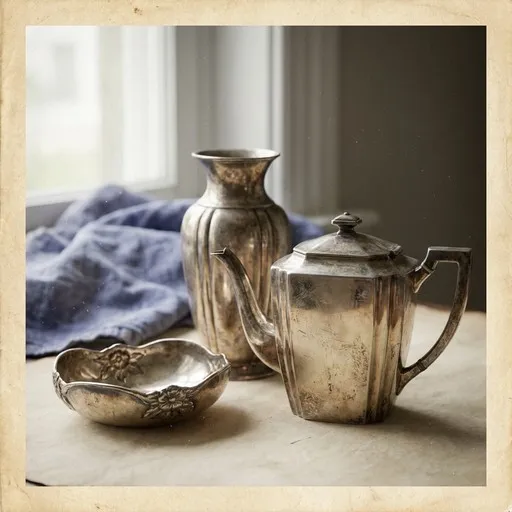
Photo: antique silver tarnished patina collection aged leather heirloom objects, via images.stockcake.com
There is a particular kind of collector who will spend considerable time and money hunting for a piece of antique silver — only to immediately set about polishing it to a state it has not known in a century. The impulse is understandable. We have been conditioned, largely by the mass market's obsession with the new, to equate visual perfection with value. And yet, among a growing and notably sophisticated segment of American collectors, that impulse is being examined, questioned, and ultimately set aside.
What is emerging in its place is something more nuanced: a philosophy of ownership that treats the evidence of time not as a liability to be corrected, but as a record to be respected.
The Language of Use
Patina, in its truest sense, is not a flaw. It is a language — one that speaks of hands, of occasions, of the passage of seasons. A mahogany writing desk whose surface has grown warm and slightly uneven with decades of daily use tells a story that no newly lacquered reproduction can approximate. The worn armrest of a well-made leather chair communicates something about the life that was lived in it. The darkened bowl of a sterling serving spoon suggests Sunday dinners and holidays and the particular weight of tradition.
This is precisely what separates a fine object from a commodity. Commodities are interchangeable. A fine object, once it has been lived with, becomes singular.
Susan Ellery, a Philadelphia-based collector who specializes in early American furniture and domestic silver, describes the shift in her own thinking as gradual but irreversible. "I used to feel a kind of anxiety when I noticed a new scratch," she says. "Now I see it as the piece becoming more itself. More honest." Ellery has not polished her silver collection in years. The pieces sit on open shelves in her dining room, their surfaces soft with age, and she considers them more beautiful for it.
Against Disposability
To understand why this sensibility is gaining ground, it helps to consider what it is reacting against. American consumer culture has, for decades, been structured around replacement rather than care. Objects are designed to become obsolete, to look dated, to be discarded. The result is a landscape saturated with things that ask nothing of their owners and inspire nothing in return.
The collector who chooses to live with a piece of hand-forged ironware, accepting its rust-tinged surface as part of its character, is making a quiet but deliberate statement against that system. So is the host who sets a table with linen napkins that have been laundered and pressed so many times that they have taken on a particular softness no new textile can replicate. These choices reflect a rejection of the throwaway — a commitment to objects worthy of sustained attention.
This philosophical realignment has a precedent in several venerable traditions. Japanese aesthetics, particularly the concept of wabi-sabi, has long celebrated the beauty of impermanence and imperfection. The cracked glaze of a well-used tea bowl, repaired with gold lacquer through the practice of kintsugi, becomes more valuable, not less, for its history of breakage. While the American collector's relationship to these ideas is inevitably filtered through a different cultural lens, the underlying recognition — that age and use are not enemies of beauty — translates with remarkable clarity.
What Patina Requires of the Collector
Embracing wear as evidence of living is not, it should be said, an excuse for neglect. There is a meaningful distinction between the patina that develops on a well-maintained object over time and the deterioration that results from indifference. The collector who understands this difference is also the one who knows how to oil a leather surface so that it ages gracefully, how to store textiles so that they do not weaken, how to handle antique wood so that it does not dry and crack.
Patina, properly understood, requires active stewardship. It is the mark of an owner who has been present — who has used the object with care and attention, who has cleaned it without stripping it, who has allowed time to work without abandoning the piece to time's less gentle effects.
This is a form of connoisseurship that goes beyond acquisition. It asks the collector not merely to have good taste in selecting objects, but to exercise good judgment in living with them.
The Market Reflects the Shift
There is evidence that this sensibility is reshaping the broader market for fine and antique objects. Dealers in early American furniture report increasing demand for pieces with their original surface intact — even when that surface is worn, faded, or otherwise imperfect — over those that have been refinished. Among serious collectors, an original surface is now widely understood to be irreplaceable. Once stripped and refinished, a piece loses something that cannot be restored.
Similarly, in the world of vintage leather goods and heritage textiles, collectors are actively seeking pieces whose age is visible. A canvas bag that has been carried for thirty years, its straps darkened with handling and its base worn to a gentle softness, commands genuine respect in communities that understand what it represents: quality that endured.
Living With What Lasts
The collector who has made peace with patina has, in a sense, made peace with time itself. They have accepted that the objects they love will continue to change — that the silver will continue to darken, that the leather will continue to soften, that the wood will continue to tell its story. And they have understood that this ongoing transformation is not something to resist but something to witness.
This is, finally, what separates the collector from the mere accumulator. The accumulator wants objects to remain as they were when acquired — static, controlled, contained. The collector enters into a relationship with an object, one that evolves over years and decades, shaped by use and care and the particular light of the rooms where the piece has lived.
At Savery Gallery, we believe that the most meaningful collections are not those frozen in immaculate display cases, but those that bear the marks of genuine engagement. A fine object, worn well, is not diminished. It is deepened.