Earth, Fire, and Intention: Why American Collectors Are Finally Taking Handmade Ceramics Seriously
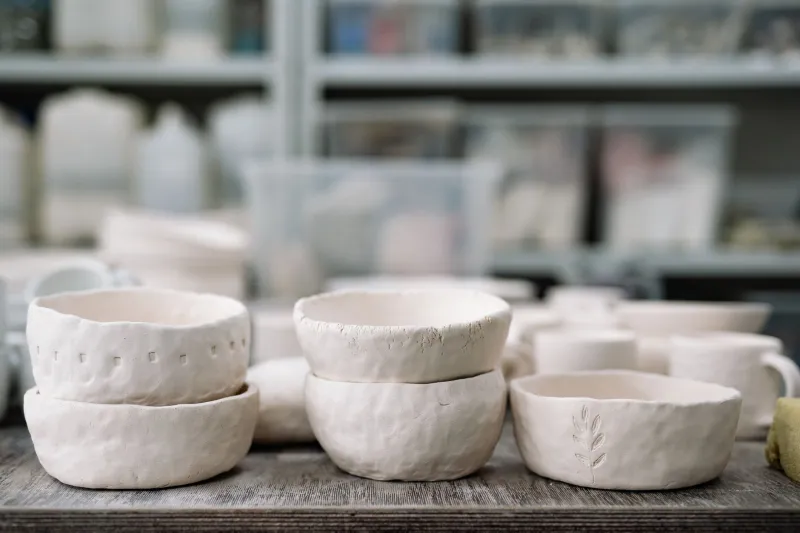
There is a particular quality of attention that serious collectors bring to the objects they acquire — a sustained looking, a willingness to sit with something before committing to it. It is the same quality that separates a collector from a shopper. And increasingly, that quality of attention is being directed at handmade ceramic vessels: the bowl thrown on a wheel in a Portland studio, the platter wood-fired in a converted barn outside of Asheville, the narrow-necked vase pulled from a kiln in the Hudson Valley.
What was once dismissed as craft — well-made, certainly, but subordinate to the so-called fine arts — is now occupying a prominent position in some of America's most thoughtfully assembled private collections. Studio ceramics have become, in the estimation of a growing number of collectors, the sleeper acquisition of the contemporary art market.
The Case for Clay
To understand why ceramics command this renewed respect, one must first appreciate what distinguishes a studio ceramic object from a manufactured one. The handmade vessel bears, in every curve and surface variation, the direct record of its making. The slight asymmetry of a thrown rim, the ghost of a fingerprint in the clay body, the unpredictable bloom of color where ash settled during a wood firing — these are not imperfections. They are the evidence of human presence, of time and intention compressed into physical form.
This is what separates studio ceramics from the decorative objects that fill the shelves of mass-market retailers. And it is precisely this quality — call it authenticity, or presence, or simply the irreducible fact of the handmade — that appeals to collectors who have already developed an eye for original art.
Susan Marr, a collector based in Chicago who began acquiring paintings in her thirties, describes the moment she began purchasing ceramics as a kind of perceptual awakening. "I had always thought of pottery as something you used," she says. "Then I held a bowl by a ceramicist I'd discovered at an art fair in Milwaukee, and I understood immediately that I was holding something that required the same quality of attention as any painting in my collection. The fact that I could also serve salad in it seemed beside the point."
A Distinct Space Between Art and Life
What makes ceramics singular as a collecting category is precisely this dual nature — the way a well-made vessel inhabits both the realm of aesthetic contemplation and the realm of lived experience. A painting hangs on the wall; you regard it from a respectful distance. A ceramic bowl sits on your table, passes through your hands, holds the warmth of whatever it contains. The relationship between collector and object is tactile, intimate, and ongoing in a way that few other art forms permit.
For collectors drawn to what might be called a savory sensibility — those who find beauty in the grounded, the material, the deeply made — this quality is not incidental. It is the point. The ceramic vessel is art that participates in daily life rather than standing apart from it, and that participation deepens rather than diminishes its meaning over time.
James Okafor, a Seattle-based architect and collector who has assembled an extensive collection of American studio ceramics over the past decade, puts it plainly: "Every time I use a piece, I understand it better. The weight of it in my hand, the way the glaze catches different light at different times of day — I know these objects in a way I simply cannot know a painting. There is an intimacy to it that I find irreplaceable."
The Artists Driving the Movement
The American studio ceramics landscape is remarkably rich, and the range of practitioners working at the highest level reflects the medium's breadth. In Los Angeles, ceramicists are producing work that engages directly with the traditions of Japanese mingei — the folk art philosophy that finds beauty in the useful — while simultaneously speaking to a distinctly West Coast aesthetic. In the American South, wood-firing traditions rooted in Appalachian folk pottery are being reinterpreted by a new generation of artists who understand both the history and the contemporary art market.
In New York, ceramicists trained at institutions such as Alfred University — long regarded as the country's preeminent center for ceramic arts education — are producing vessels that command gallery prices commensurate with their ambition. Work by graduates of Alfred's MFA program now appears regularly in juried exhibitions alongside painting and sculpture, a positioning that would have seemed aspirational a generation ago.
The collectors who are paying attention to these artists are not simply buying objects. They are acquiring works by practitioners who have spent years — in many cases, decades — developing a visual language that is entirely their own. The glaze palette of a ceramicist who has spent fifteen years refining a single reduction firing technique is as distinctive and as deliberately arrived at as the brushwork of a painter.
Entry Point and Long-Term Value
For new collectors, ceramics offer something that few other categories in the contemporary art market can match: genuine accessibility paired with genuine artistic merit. While museum-quality works by established studio ceramicists can command prices in the tens of thousands of dollars, exceptional work by emerging artists is frequently available in the three-hundred to two-thousand dollar range — figures that place serious original art within reach of collectors who might hesitate before a painting at the same level of ambition.
This accessibility is not a signal of lesser value. It is, rather, a reflection of the fact that the broader market has not yet fully caught up to what the most discerning collectors already understand. Those who are acquiring studio ceramics now — particularly works by artists with strong exhibition records and institutional recognition — are doing so at a moment that experienced collectors recognize as opportune.
Marr, who has watched her early ceramic acquisitions appreciate significantly, is candid about this dimension. "I bought what I loved, and I bought it because it moved me," she says. "But I also bought it knowing that the market for handmade ceramics was only going to deepen as more collectors began to see what I was seeing. That has proved to be the case."
How to Begin
For those considering their first serious ceramic acquisition, the approach mirrors that of any thoughtful collecting practice: look widely before committing, seek out artists with a coherent and developed body of work, and prioritize pieces that generate a sustained rather than an immediate response.
Studio visits — offered by many American ceramicists, particularly those working outside major metropolitan areas — provide an invaluable opportunity to understand an artist's process and to handle works directly before purchasing. Juried craft exhibitions, ceramic arts festivals in cities such as Philadelphia, Santa Fe, and Minneapolis, and the growing number of galleries dedicated exclusively to studio ceramics are all productive starting points.
Above all, the new ceramics collector is encouraged to resist the impulse to separate the beautiful from the useful. The vessel that holds fruit on your kitchen counter, that you reach for each morning, that you wash and dry and return to its place — that object, if it is made with true intention, is as worthy of serious collection as anything behind glass.
The earth from which it came has been transformed by fire and human skill into something that will outlast both the maker and the collector. That, in the end, is precisely what art is for.