Inside the Making: A Collector's Guide to Understanding the Artist's Studio and Process
The finished work on a gallery wall tells only part of the story. For collectors who wish to develop a genuinely informed relationship with original art, the studio — that intimate, often chaotic space where decisions are made and unmade — offers an education available nowhere else. Learning to read a working environment, and to ask the right questions within it, transforms the act of acquisition into something far richer than the simple exchange of a work for its price.
Process knowledge is one of the most undervalued tools in the serious collector's arsenal. Understanding how a work came to be — what materials were chosen and why, what was abandoned before the final image emerged, how long a piece lived in the studio before the artist considered it resolved — changes the way you see the finished object. It adds a temporal dimension to your appreciation, an awareness that what hangs on your wall is not simply an image but the record of a series of consequential decisions.
Why the Studio Visit Is Irreplaceable
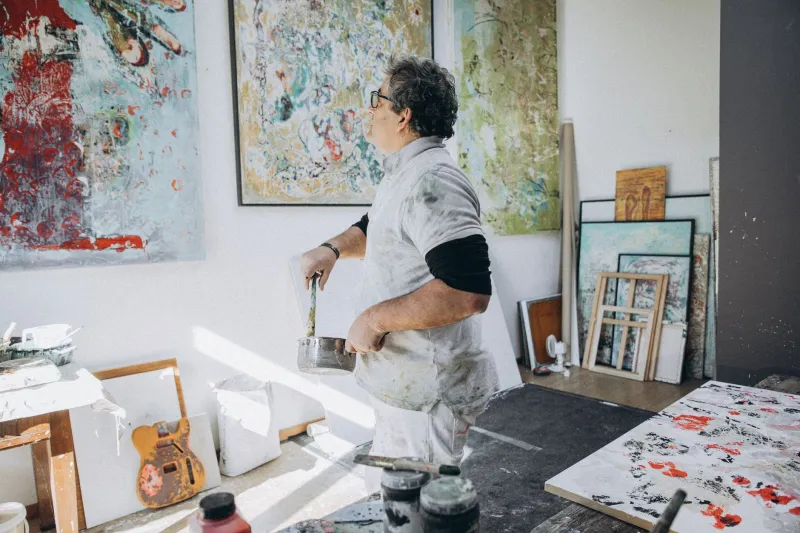
No catalog essay, however accomplished, can substitute for standing in the room where work is made. The studio is the artist's laboratory, library, and confessional simultaneously. It holds the evidence of practice: the works in progress, the studies pinned to the wall, the materials arranged with the idiosyncratic logic of a working mind.
For the collector, this environment communicates things that finished works alone cannot. A studio filled with hundreds of small studies suggests an artist who thinks through drawing, who uses paper as a thinking tool rather than merely a preparatory step. A studio organized around a single large-scale project, with reference images and material samples clustered nearby, reveals a different kind of intelligence — one that commits deeply to sustained inquiry. Neither approach is superior; both are meaningful, and knowing which describes the artist whose work you are considering enriches your understanding of every piece they produce.
Beyond the intellectual dimension, the studio visit establishes a human relationship. You are meeting the maker, not merely the made. This matters enormously over the long arc of collecting. Artists whose work you have encountered in person, whose hands you have shaken, whose working philosophy you have heard described in their own words — these are the artists whose careers you follow with genuine investment. Their successes become a source of satisfaction; their development over time becomes a narrative you are privileged to witness.
How to Arrange a Studio Visit
For collectors new to this practice, the logistics can feel uncertain. In fact, most working artists — particularly those at earlier stages of their careers — welcome studio visits from serious collectors and are accessible through direct inquiry, gallery introductions, or open studio events.
Many American cities host annual or seasonal open studio programs, in which artists invite the public into their working spaces over a designated weekend. These events are an excellent starting point. They allow you to encounter multiple artists in a low-pressure context, to identify whose work warrants a return visit, and to begin building the conversational relationships that lead to deeper engagement.
For artists you have already identified through gallery exhibitions or art fairs, a visit can often be arranged through the representing gallery. A brief, genuine expression of interest in the work — not merely in purchasing, but in understanding — is almost always received warmly. Artists are, above all, people who wish for their work to be genuinely seen.
What to Look For, and What to Ask
Arriving at a studio with prepared questions is useful; arriving with rigid expectations is not. The most productive studio visits are conversations, not interrogations. Begin by looking — at the work on the walls, at the materials in use, at the objects the artist has chosen to surround themselves with. What an artist keeps close tells you something about what they value.
When conversation opens, consider asking about materials and why they were chosen. An artist who works in encaustic — the ancient medium of pigmented beeswax — has made a choice laden with implications about surface, depth, and the relationship between transparency and opacity. An artist who grinds their own pigments from mineral sources is making a statement about connection to historical practice and the specificity of color that no commercially prepared paint can replicate.
Ask about failure. The most illuminating studio conversations often center not on what succeeded but on what was abandoned. Understanding what an artist rejects reveals the standards by which they judge their own work — and those standards are the true measure of their seriousness.
Ask about time. How long does a given work typically occupy the studio before it is considered finished? Artists who work quickly are not necessarily less rigorous than those who labor over a single canvas for months; but the answer tells you something about the nature of the decisions being made and the relationship between intuition and deliberation in their practice.
Using Process Knowledge to Inform Acquisition
The insights gathered during a studio visit should actively inform how you approach acquisition. Understanding that a painter works in extended series, for instance, suggests that acquiring a single work may eventually feel incomplete — that the piece will be most fully understood in relationship to others from the same body of inquiry. Some collectors build their holdings around this awareness, acquiring works that speak to one another across a studio's evolution.
Material knowledge also shapes long-term stewardship decisions. Works on paper require different conservation conditions than oil on canvas; certain pigments are more light-sensitive than others; some contemporary media — resin, photographic emulsion, certain synthetic fabrics — carry specific archival considerations that a collector should understand before acquisition. An artist will almost always share this information willingly; it is, after all, in their interest that the work endures.
The Studio as the Beginning of the Story
The most sophisticated collectors understand that the acquisition of a work of art is not the end of a relationship but the beginning of one. The object you bring home carries with it the memory of where it was made, by whom, and through what sequence of choices. That knowledge does not diminish over time. It deepens.
A painting whose making you witnessed in part — whose studio you visited, whose artist you spoke with at length — is not the same object as a painting purchased from a reproduction in a catalog. It is inhabited by a different quality of attention, yours and the artist's both. And that quality of attention is, finally, what distinguishes a collection from a decoration.
Step inside. The conversation that matters most begins before the work ever leaves the studio.