Set the Ancestral Table: How Serious American Cooks Are Preserving Family Recipes as Cultural Heirlooms
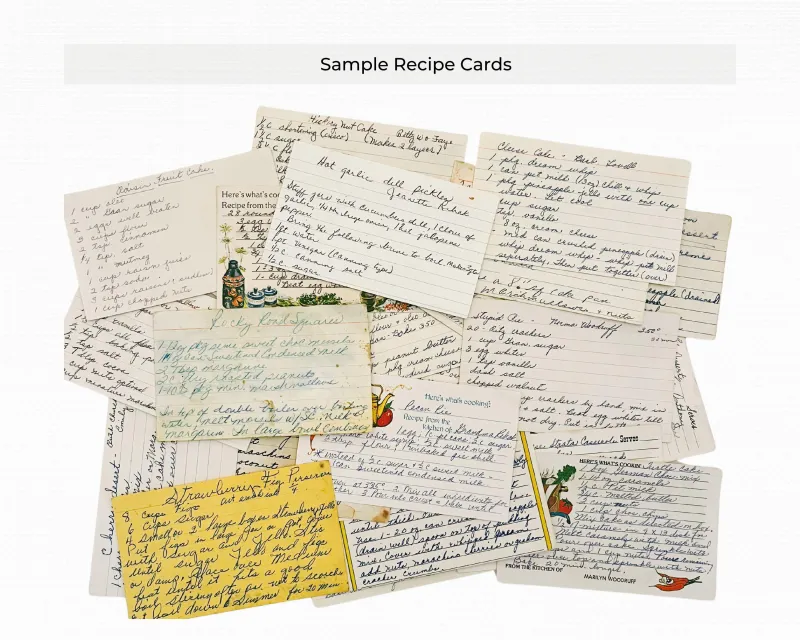
Photo: handwritten vintage recipe cards heirloom ingredients family kitchen heritage cooking, via i.etsystatic.com
In a corner of her New Orleans kitchen, Delphine Arceneaux keeps a binder so worn that its cover has been reinforced with electrical tape. Inside are recipes written in at least four different hands, spanning three generations — some in French, some in the particular Creole shorthand of her grandmother's parish, some annotated so heavily in pencil that the original ink is barely visible beneath the revisions. She has never considered digitizing it. "If I put it on a screen," she says, "it stops being what it is."
What it is, she would tell you, is not a recipe collection. It is an archive. A primary source. A document of who her family was, where they came from, and what they considered worth preserving and passing forward.
Across the United States, a growing and notably intentional community of home cooks, hosts, and culinary enthusiasts is arriving at a similar understanding: that the family recipe, properly regarded, is among the most significant cultural artifacts a household can possess — and that its preservation demands the same seriousness of purpose that one might bring to the care of a fine painting or a piece of antique silver.
The Recipe as Primary Document
Historians have long understood that cookbooks and recipe manuscripts offer a window into daily life that more formal documents frequently obscure. They record not only what people ate but how they thought about nourishment, hospitality, economy, and celebration. A handwritten recipe for a holiday cake, passed from grandmother to granddaughter in 1943, carries within it information about wartime rationing, regional flavor preferences, the particular equipment available in that kitchen, and the relationship between the two women who exchanged it.
The collector's instinct — to recognize and protect objects of genuine significance — applies here with full force. And yet, unlike a painting or a piece of furniture, a recipe exists in a peculiarly fragile form. It can be lost in a single household move, destroyed in a kitchen accident, or simply forgotten when the person who held it in living memory is no longer present to share it.
This fragility is precisely what motivates the most committed practitioners of culinary heritage preservation. They have understood that the window for recovery can close with a generation.
Ingredients as Artifacts
The preservation impulse extends beyond the recipe itself to the ingredients it calls for — and here the work becomes genuinely complex. Many ancestral recipes were written for ingredients that no longer exist in their original form: specific regional varieties of corn, dry beans that have not been commercially available for decades, cured meats made according to methods that died with the last practitioner in a given community.
This has given rise to a meaningful intersection between culinary heritage and the broader movement to preserve heirloom and heritage varieties of food crops. Organizations such as the Seed Savers Exchange in Decorah, Iowa, and the work of researchers at land-grant universities across the South and Appalachia are engaged in the agricultural equivalent of archival preservation — maintaining genetic diversity in food plants that might otherwise vanish entirely.
For the serious home cook, sourcing these ingredients is itself a form of collecting. The Appalachian heirloom bean, the Carolina Gold rice, the Bloody Butcher corn — these are not merely culinary choices. They are decisions to engage with a living material history, to cook with ingredients whose lineage can be traced and whose flavor carries the particular character of a specific soil, climate, and agricultural tradition.
Thomas Birdsong, a Tennessee-based cook and food historian whose work centers on the foodways of the Upper South, describes the experience of cooking a dish with historically accurate ingredients as fundamentally different from preparing a modern approximation. "When you use the right corn," he says, "the dish becomes a time document. You're not just eating something good. You're tasting a specific moment in American history."
The Table as Gallery
For those who have adopted this framework, the act of setting a table for a heritage meal takes on dimensions that go well beyond hospitality. It becomes curatorial. The dishes chosen, the linens used, the serving pieces brought out — all of it can be assembled with the same intentionality that a gallery director brings to an exhibition.
Some practitioners document their heritage meals with the same rigor they might bring to cataloguing a collection: photographing dishes alongside the handwritten recipes that produced them, noting the provenance of key ingredients, recording oral histories from family members who remember the dish in its original context. The meal becomes an event around which memory is gathered and preserved.
This is not, it should be emphasized, a nostalgic exercise. The most thoughtful practitioners of culinary heritage preservation are not attempting to freeze the past in amber. They are engaging with it dynamically — adapting techniques to modern equipment where necessary, adjusting recipes to account for ingredients that have changed, and making deliberate choices about which elements are essential to preserve and which can evolve. This is precisely the kind of informed, active stewardship that distinguishes the serious collector from the mere accumulator of objects.
What Is at Stake
The stakes of this work are not trivial. American culinary heritage is, in many respects, a story of extraordinary diversity — of African, Indigenous, European, and Asian traditions converging, colliding, and ultimately producing something entirely new. Much of that heritage has already been lost, either through the ruptures of history or the more gradual erosion of assimilation and commercial food culture.
What remains is irreplaceable. A recipe that survives in a single handwritten copy, in the possession of one family, represents a thread of cultural continuity that, once broken, cannot be rewoven. The decision to treat it with the seriousness it deserves — to document it, to cook from it, to share it with intention — is an act of cultural responsibility.
It is also, for those who practice it well, an act of genuine pleasure. The heritage meal, prepared with care and eaten in good company, offers something that no restaurant and no mass-produced food product can replicate: the particular satisfaction of tasting where you come from.
Beginning the Archive
For those moved to begin this work, the entry point is simpler than it might appear. It starts with a conversation — with a parent, a grandparent, an aunt or uncle — about the dishes that defined a household, the occasions they marked, the techniques that were never quite written down. It continues with the decision to write those things down, or to record them, before they exist only in living memory.
From there, the archive grows: a recipe preserved, an ingredient sourced with care, a meal prepared and shared and documented. Each iteration deepens the record and honors the tradition that produced it.
At Savery Gallery, we understand that the most meaningful collections are those that connect us to something larger than ourselves. The ancestral recipe, held with care and cooked with intention, does exactly that — placing the collector not at the end of a tradition, but in the middle of one, responsible for passing it forward.