The Open Studio: How Independent American Artists Are Rewriting the Rules of Collecting
For much of the twentieth century, the path between an artist and a collector ran almost exclusively through an intermediary. The gallery held the keys — to pricing, to access, to the carefully managed narrative surrounding an artist's work and reputation. Collectors accepted this arrangement, in part because there was no credible alternative, and in part because the institution itself carried a kind of authority that felt, if not entirely comfortable, at least legible.
That arrangement is changing. And the change is arriving not from the top of the market but from the studio floor.
The Geography of Discovery
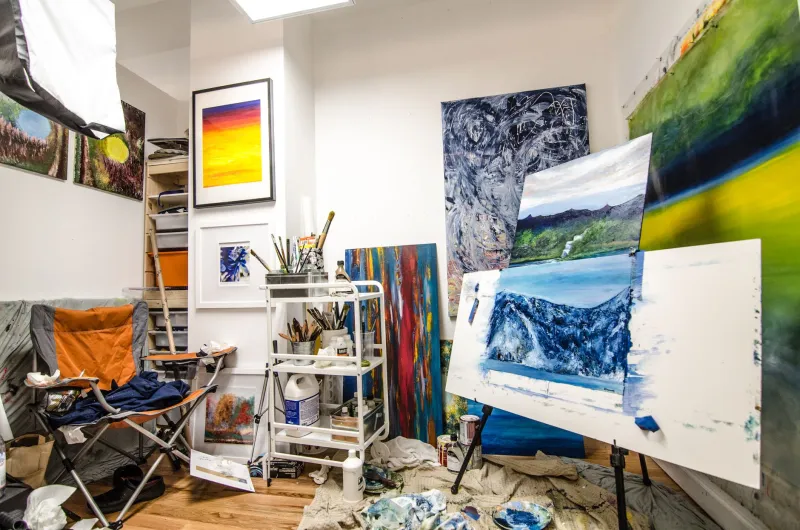
In Portland, Oregon, a painter named Elise Hartmann opens her studio on the first Saturday of every month. She sends a brief notice to a list of roughly four hundred people — former buyers, curious neighbors, fellow artists, and strangers who found her work online — and she makes coffee. Between forty and seventy people typically arrive. Some come repeatedly. Several have become significant collectors of her work, acquiring multiple pieces over the course of years, without a gallery ever entering the equation.
"There's something that happens when someone sees a painting in the room where it was made," Hartmann says. "They understand it differently. They're not reading a wall label or a price list — they're standing in the context. And that changes what they're willing to feel about it."
Hartmann's model is neither unique nor particularly new in its basic form. Artists have always opened their studios, particularly during sanctioned events like open-studio weekends organized by local arts councils. What is new is the intentionality, the frequency, and the directness with which a growing number of American artists are treating the studio not merely as a workspace but as a primary point of sale and relationship-building.
Bypassing the Gatekeepers
The traditional gallery model, for all its institutional authority, carries significant costs — for both parties. Artists working with commercial galleries typically surrender between forty and sixty percent of each sale price to the gallery, in exchange for representation, exhibition space, marketing, and access to the gallery's collector network. For established artists with strong secondary market presence, this arrangement can function well. For emerging and mid-career artists working outside major metropolitan centers, it has often felt less like a partnership and more like a toll.
The studio-direct movement represents, among other things, a practical response to this economics. When an artist sells directly from the studio, they retain a substantially greater share of the sale price. This is not merely a financial improvement — it is a structural one. It allows artists to price their work more accessibly without compromising their income, to build sustained relationships with individual collectors, and to maintain creative control over how their work is presented and contextualized.
For collectors, the arithmetic is equally favorable. Work acquired directly from the artist is frequently priced below comparable pieces sold through gallery channels. More significantly, the collector gains something that no gallery transaction can fully replicate: a direct relationship with the maker.
The Digital Studio Visit
The studio-direct model has been considerably amplified by the tools of contemporary digital life. Artists who might once have been geographically isolated from major collector markets — working in rural Vermont, in the high desert of New Mexico, or in the post-industrial neighborhoods of Detroit — now maintain active presences on platforms that allow collectors anywhere in the country to follow their process in something approaching real time.
Live-stream studio sessions, in which artists work in front of a camera and field questions from viewers, have proven particularly effective at translating the intimacy of a physical studio visit into a digital format. Several artists working in this mode report that their most committed collectors are people who have never visited their studios in person but who feel, through sustained online engagement, a genuine familiarity with the work and the working process.
This is not a diminished form of connection. For many collectors, following an artist's process over months or years — watching a body of work develop, understanding the decisions and reconsiderations that shape each piece — produces a depth of engagement that a single gallery visit, however well-curated, rarely achieves.
What Collectors Are Actually Buying
When collectors speak about studio-direct acquisitions, they consistently return to a word that is not often heard in gallery contexts: authenticity. This is a term that can carry a certain vagueness, but in this setting it has a specific meaning. Collectors who buy directly from artists report feeling that they understand, with unusual clarity, what they have acquired — not simply as an object, but as an artifact of a particular creative life.
"I know which painting she almost discarded," says Marcus Okafor, a Houston-based collector who has purchased seven works from a single Brooklyn-based painter over four years, all through direct studio transactions. "I know which one she finished in two hours and which one took six weeks. That knowledge doesn't change what the painting looks like, but it changes how I live with it."
This quality of knowing — the provenance that extends not merely to geography and medium but to process and intention — is precisely what the studio-direct model offers that the gallery system, by its nature, cannot. A gallery presents a finished object in a neutral context. A studio presents a finished object in the context of its own becoming.
A Smarter Way to Collect
For collectors who have not yet explored the studio-direct landscape, the entry points are more numerous and more welcoming than they may appear. Open-studio events, artist-run newsletters, and curated online platforms that facilitate direct artist-collector relationships have all made the process considerably more navigable than it was even a decade ago.
A few principles tend to serve collectors well in this space:
Develop relationships before making acquisitions. The studio-direct model rewards patience and genuine curiosity. Follow artists whose work interests you, attend open studios without the pressure of an immediate purchase, and allow your understanding of an artist's practice to deepen before committing.
Ask questions. One of the singular privileges of buying directly from an artist is the ability to ask, directly, about the work. What was the artist thinking? What problem were they solving? What does this piece mean within the larger arc of their practice? These conversations are not only illuminating — they are part of what you are acquiring.
Think in terms of relationships, not transactions. The most rewarding studio-direct collecting tends to unfold over time, as a sustained engagement with an artist's evolving work rather than a series of isolated purchases.
The Studio as Cultural Institution
What is emerging, across the country and across disciplines, is something that functions less like a marketplace and more like a new kind of cultural institution — one organized around directness, transparency, and the primacy of the maker-collector relationship. The white wall has not disappeared, and it need not. But it is no longer the only wall worth standing in front of.
For collectors with a genuine appetite for art that is discovered rather than prescribed, the studio door — whether encountered in person on a Saturday morning in Portland or through a screen on a Tuesday evening from anywhere in the country — represents one of the most compelling invitations currently available in American art. The work waiting on the other side of it has not been filtered, repositioned, or marked up. It has simply been made, by someone who would very much like you to see it.